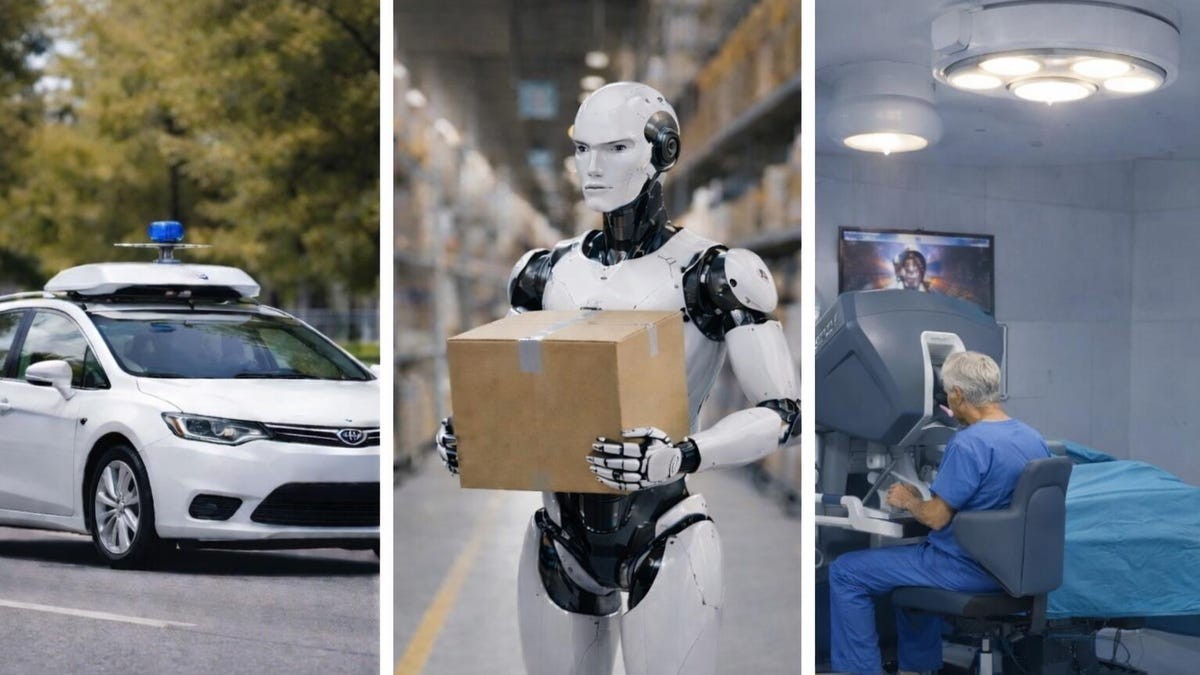
Artificial intelligence (AI) is no longer confined to screens; it’s rapidly transitioning into the physical world, embedding itself in machines that sense, decide, and act. This shift from digital to embodied intelligence – often called physical AI – represents a fundamental change in how we interact with technology, and its growth is accelerating.
The Expanding Physical AI Market
The global physical AI market is projected to reach approximately €430 billion ($500 billion) by 2030, according to a PwC study. This rapid expansion isn’t just about better robots; it reflects a fundamental need for automation and intelligence in real-world applications. From self-driving cars to surgical robots, physical AI is poised to reshape industries and daily life.
What is Physical AI?
Unlike chatbots that exist purely in the digital realm, physical AI merges artificial intelligence with hardware. These systems use sensors – cameras, lidar, microphones, environmental detectors – to gather real-time data about their surroundings. They then process this information to control motors, wheels, robotic arms, and other components, allowing them to respond to the physical world.
This isn’t simply “ChatGPT in a robot,” as robotic systems engineer Zhengyang Kris Weng points out. The stakes are higher: a miscalculation by a delivery robot can cause real-world harm, unlike a chatbot’s fabricated citation.
How Physical AI Works: The Perception-Decision-Action Loop
Physical AI operates through a continuous cycle of perception, decision-making, action, and learning. Machines analyze incoming data to understand their environment, relying on technologies like:
- Computer vision: Interpreting what cameras see.
- Machine learning: Recognizing patterns and predicting outcomes.
- Reinforcement learning: Improving through trial and error.
- Agentic reasoning: Planning multiple steps ahead for complex actions.
This process isn’t seamless. AI must filter chaotic data to distinguish critical details – a child’s backpack from a mailbox in heavy rain, for example. A fraction-of-a-second lag in this loop can lead to catastrophic failures, such as a self-driving car crash or a robot malfunction.
Examples of Physical AI in Action
Physical AI is already prevalent in many sectors:
- Autonomous vehicles: Companies like Waymo and Tesla deploy AI-driven systems to interpret sensor data and control vehicles.
- Robotics: Industrial robots in Amazon warehouses use AI to sort packages. Humanoid robots, like Tesla’s Optimus, are entering development. Even home robots like Roomba utilize basic physical AI for navigation.
- Medical robotics: Surgical systems like da Vinci assist doctors with precise movements.
- Smart Cities: Projects like Toyota’s Woven City aim to integrate AI into urban infrastructure, running simulations via digital twins – virtual replicas of real-world environments.
These systems are often narrowly focused; a warehouse robot excels at picking boxes but struggles in a grocery store. Self-driving cars perform well on highways but falter in unpredictable situations like construction zones.
The Difference Between Generative and Physical AI
Generative AI, like ChatGPT, predicts patterns in data. Physical AI predicts outcomes in dynamic, real-world environments. Training a chatbot costs little more than electricity; training a self-driving car requires real-world testing, accounting for unpredictable factors like gravity, black ice, or obstructed signs.
To reduce these costs, developers use digital twin simulations and world foundation models to generate synthetic data. However, even these simulations struggle to replicate the complexities of reality, such as friction, contact, and the chaotic behavior of humans and animals.
Reliability, Safety, and the Edge Cases
As AI moves into the physical world, reliability becomes paramount. Sensors fail, cameras are blinded by glare, and people behave unpredictably. Most systems handle common scenarios but struggle with “edge cases” – overturned trucks, sudden obstacles, erratic drivers.
Unlike software glitches, mechanical errors have real-world consequences. A buggy app can be updated; a robot malfunction can cause damage or injury. Current safeguards are insufficient; even 99% reliability means one in a hundred failures can still cause significant harm.
The Future of Physical AI: Embodied Intelligence
Researchers are exploring “embodied AI,” where machines learn through physical interaction. This approach promises advancements in elder care, disaster response, and autonomous agriculture. Warehouses could become fully automated, and cities could operate with greater efficiency.
Physical AI is no longer a futuristic concept; it’s a growing reality. As machines become more capable of sensing, deciding, and acting in the real world, the line between digital intelligence and physical presence will continue to blur.