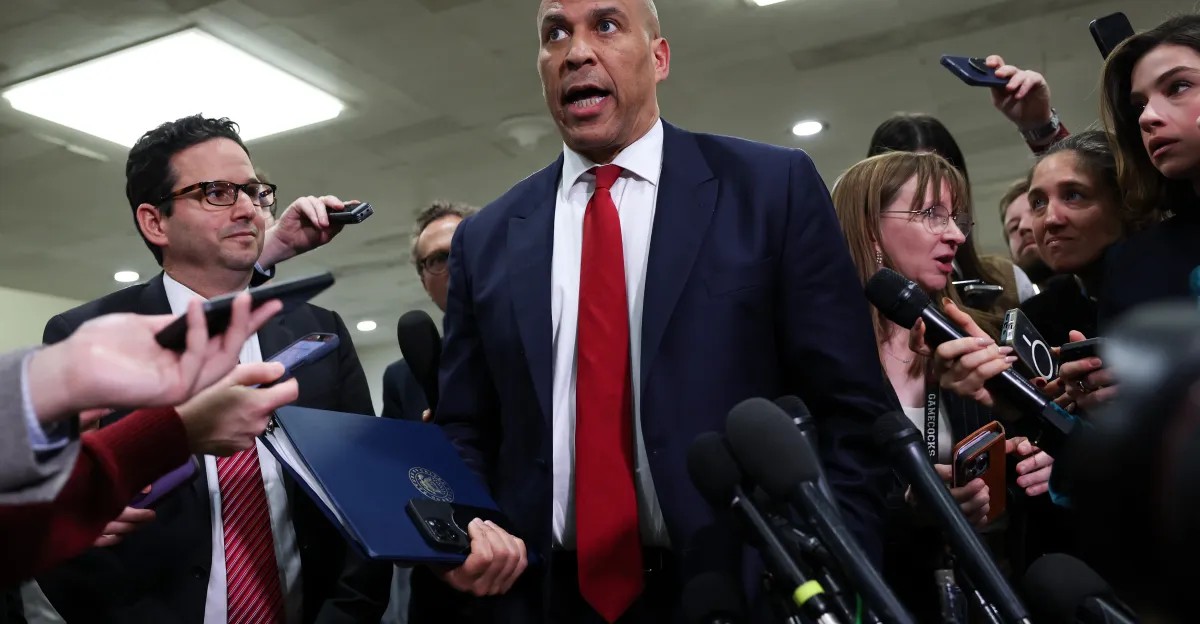
The Democratic Party is considering a sweeping, yet potentially unsustainable, policy: massive tax cuts for the middle class. Proposals from Senators Cory Booker and Chris Van Hollen aim to eliminate federal income taxes for millions of Americans, financed by increased taxation on the wealthiest citizens. However, this approach clashes directly with the party’s own ambitions for expanding social welfare programs.
The Proposed Tax Cuts
Van Hollen’s plan would exempt individuals earning under $46,000 and couples under $92,000 from federal income taxes (excluding payroll taxes). Booker’s proposal goes further, eliminating federal income tax on the first $75,000 in earnings. Both senators intend to fund these cuts by increasing taxes on the ultra-rich, mirroring former President Trump’s appeal to working-class voters with policies like exempting tipped income from federal taxes.
The Rising Trend of “99 Percentism”
This shift reflects a long-term trend in Democratic politics toward relying almost exclusively on the top 1% to finance government spending. For decades, Democrats traditionally balanced tax burdens across income levels. However, since the 1990s, the party has become increasingly hesitant to raise taxes on the middle class, a reluctance reinforced by public distrust in government and a growing dependence on upper-middle-class support.
Incompatibility with Welfare Expansion
The core issue is that these tax cuts are mathematically incompatible with the Democrats’ stated goals of expanding social programs. Van Hollen’s plan would reduce federal revenue by $1.5 trillion, while Booker’s would slash it by over $5.5 trillion. Yet, both senators simultaneously support major expansions of welfare, including subsidized childcare, universal healthcare, free college tuition, and a child allowance.
These initiatives combined would increase federal spending by over $30 trillion over a decade. Even if aggressive taxes on the wealthy were implemented, the revenue generated would likely be insufficient to cover both tax cuts and expanded social benefits without unsustainable deficits.
Why Taxes on the Rich Aren’t a Magic Bullet
Relying heavily on taxes on the ultra-rich has limitations. Billionaires can shield their wealth through loopholes or move capital overseas. Moreover, even substantial taxes on the wealthy may not prevent inflation when combined with increased government spending.
Western European welfare states, often cited as models, do not rely primarily on taxing the rich. Instead, they maintain broad-based taxation across income levels. The U.S. already taxes the middle class lightly compared to historical rates, and further cuts would exacerbate fiscal imbalances.
Political Realities and Fiscal Constraints
Moderate Democrats will inevitably constrain how aggressively the wealthy can be taxed. Even under full Democratic control, the party’s Senate majority will likely be narrow, giving centrists veto power over fiscal policy. This means that every dollar dedicated to middle-class tax cuts is a dollar unavailable for social welfare expansion.
Conclusion
The Democratic proposals for broad middle-class tax cuts are fiscally unsound and strategically questionable. While politically appealing, they create an unsustainable trade-off between tax cuts and welfare spending. The reality is that a robust welfare state cannot be funded solely by taxing the rich; Democrats must either scale back their spending ambitions or accept higher overall tax burdens.