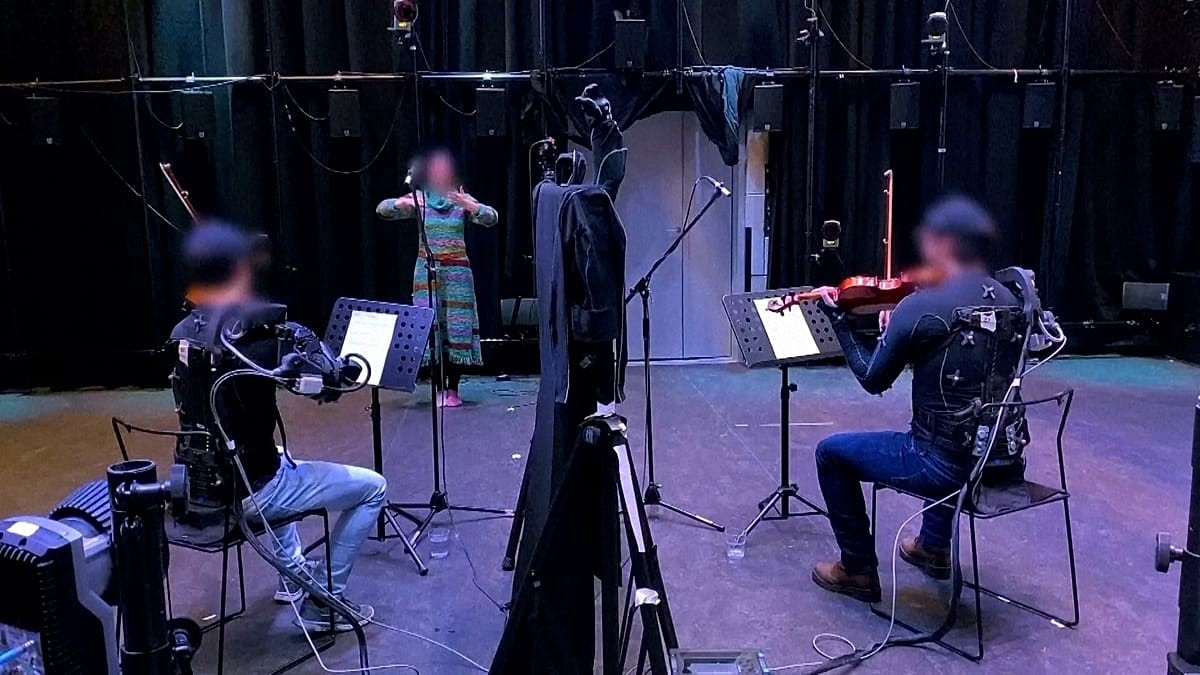
A new study from Italy demonstrates that robotic exoskeletons can significantly improve musical coordination between performers by delivering subtle haptic feedback. Researchers at Università Campus Bio-Medico found that replacing visual cues with robotic-assisted touch enhanced both the precision of musicians’ movements and the quality of their synchronized performance.
How the Experiment Worked
The study involved professional violinists wearing exoskeletons on their bow-playing arms. These devices monitored and adjusted their movements in real time, using bidirectional forces to subtly align their timing. Participants were tested under four conditions:
- Hearing and seeing each other (traditional method).
- Hearing only (vision blocked).
- Hearing only with the exoskeleton active.
- Full sensory feedback with the exoskeleton.
Infrared cameras and sensors tracked their arm angles, shoulder positions, and bow force, confirming that the haptic feedback from the exoskeletons led to better synchronization than relying solely on sight or sound.
The Science Behind the Improvement
Francesco Di Tommaso, a robotics researcher involved in the study, explained that the exoskeletons create a “virtual communication” between performers. “The movements recorded by one exoskeleton are transmitted to the other,” meaning that when one musician’s timing drifts, the device gently nudges them back into sync.
Participants initially reported discomfort from the forces, unaware they were coming from their partner. However, the data showed that these forces paradoxically improved their coordination. The researchers found that replacing visual cues with haptic feedback actually enhances both kinematics and musical alignment.
Beyond Music: Potential Applications in Rehabilitation
While the study focused on musical performance, the underlying technology could have broader applications. Professor Domenico Formica, a bioengineer on the team, suggested using similar systems in motor rehabilitation.
“The same concept may be applied to several fields… in motor rehabilitation, we usually have patients that interact with the robot to improve their recovery. Using this technology, a therapist could interact with a patient, and this bilateral exchange of forces may improve recovery.”
This approach could also allow two patients to work together during therapy, creating a more challenging and potentially effective recovery process.
The study highlights how robotics can refine human coordination in unexpected ways, opening doors for innovative applications beyond the performing arts.