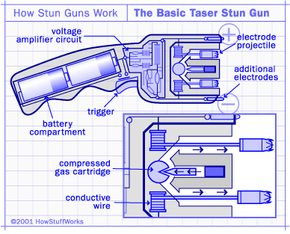
The concept of a “Taser gun” is a distinct evolution from the traditional stun gun. While they share the same fundamental mechanism—delivering an electrical shock to incapacitate—they operate quite differently. A standard stun gun requires direct contact. The two electrodes are fixed firmly to the housing. You have to touch the victim to trigger the circuit. A Taser breaks that physical tether.
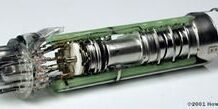
Instead of being part of the gun’s body, the electrodes sit at the end of long, conductive wires. These wires remain attached to the electrical circuit inside the device. When you pull the trigger, something mechanical happens. A compressed gas cartridge inside the gun shatters. The expanding gas creates pressure. This pressure pushes the electrodes out of the barrel. They fly through the air like projectiles. The wires trail behind them, connecting back to the gun. It is a firing mechanism almost identical to that of a BB gun.
Once these electrodes leave the barrel, they rely on physics to stay attached. The tips are fitted with small barbs. If they hit a target, those barbs catch onto clothing or skin. The connection is made. The high-voltage current then travels down the conductive wires. It enters the attacker’s body. The result is neuromuscular incapacitation. The person freezes up. It is the same effect you would get from a conventional stun gun, but achieved from a distance.
The Range and Reload Trade-off
The obvious benefit of this design is range. You can engage a threat from significantly farther away than you could with a contact device. Most models offer a typical effective range of 15 to 20 feet. That is roughly 4 to 6 meters of separation. In a self-defense scenario, that extra distance can mean the difference between safety and danger.
There is a catch, however. You generally get only one shot. The mechanism is expendable. Once you fire, the gas cartridge is empty. The wires are deployed. To use the device again, you have to manually wind up the electrode wires. You must also load a fresh gas cartridge into the chamber. It is not a quick reload.
This limitation is why most Taser models include a backup. Beneath the projectile ports, there are usually conventional stun-gun electrodes. If your first shot misses or the wires fail to catch, you can press the gun against the target and trigger the standard circuit. It turns a ranged weapon into a close-quarters club, effectively giving you two methods of attack in one package.
Tracking and Identification
Law enforcement agencies care about more than just stopping a suspect. They care about accountability. Some Taser models address this with a built-in shooter-identification system. When an officer fires the weapon, the gun does not just shoot electricity. It also releases dozens of confetti-sized identification tags.
These tiny tags contain specific data. They tell investigators which specific gun was fired. They can even indicate the location of the discharge. This creates a paper trail for every incident. Other models go a step further. They integrate a computer system that records the exact time of every shot. This data logging helps in reviewing use-of-force incidents and ensuring protocol compliance.
The Dark Side of Electrical Restraint
These devices are powerful. That power comes with ethical weight. The manufacturers explicitly state that stun guns should be used conservatively. The intended purpose is self-defense. It is for incapacitating an unruly person who poses an immediate threat. It is not a tool for interrogation.
Yet, globally, that is exactly how they are used. Amnesty International has documented governments routinely using stun weapons to extract confessions from political prisoners. The method is appealing to torturers because it leaves little physical evidence. The shock is excruciating. It causes immense pain. But it rarely leaves a visible wound. There are no bruises that look like handprints. No broken bones that show up clearly on initial exams. The lack of obvious trauma makes it harder to prove abuse in a court of law.
While a stun gun might be a relatively safe tool when used correctly for protection, it becomes a dangerous instrument in the wrong hands. The line between defense and torture