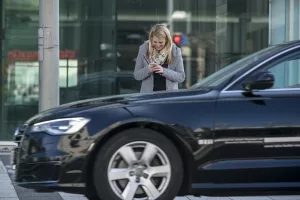
It is not just drivers who turn a steering wheel into a death trap. Look around. The sidewalk is littered with them. Heads down. Eyes locked on a glowing rectangle. We call it “phubbing” when you ignore a friend for your phone. In traffic, it is just reckless.
Traffic experts are sounding the alarm. And they are right to be.
Crossing the street has become a test of luck rather than skill. Because thousands of people still tap, swipe, and scroll while stepping into the path of moving vehicles. They do not look up. They do not check for oncoming cars. They just walk.
“Fatale Folgen.” Fatal consequences. That is the warning from the experts. It is not hyperbole. It is a statistical reality waiting to happen.
This is not a new problem, but the scale has shifted. A decade ago, distracted driving was the headline. Now, the focus is shifting to the person on the pavement. The smartphone has become an anchor. It pulls your gaze down and your awareness down with it.
Consider the mechanics of it. You are walking. Your brain is processing the visual field. It is looking for cars. It is looking for cyclists. It is looking for the gap in traffic that lets you cross safely. Then, a notification pops up. Or you just decide to check a message. The gaze drops. The peripheral vision narrows. The brain stops scanning for threats.
You step off the curb. You are blind.
This is not about being careless in the abstract. It is about specific, deadly moments. A car turns the corner. A bus pulls away. A bicycle swerves. The pedestrian, eyes still on the screen, does not see the danger until it is too late. The impact is rarely minor.
Why does this happen? It is addiction. It is habit. It is the dopamine hit of a new message pulling at the mind. We have trained ourselves to prioritize the digital over the physical. The screen is immediate. The street is background noise. Until a horn blares. Or a collision occurs.
The danger is not theoretical. It is happening on every street corner. Every zebra crossing. Every intersection where the light changes and the “walk” signal flashes. People walk forward with their thumbs hovering over the glass. They are ghosts in the machine.
And the vehicles are real. They weigh tons. They move fast. They do not stop for ghosts.
So, the next time you step out into the street. Put the phone away. Look up. The world is not waiting for your next scroll. It is moving. And it might hit you.
Pedestrians, phones, and the death of situational awareness
It feels harmless enough. You’re crossing the street. You check a notification. It takes two seconds. But in urban environments, two seconds is an eternity.
We’ve normalized the “distracted pedestrian.” The image is ubiquitous: someone navigating a crosswalk with eyes glued to a screen, thumbs flying across glass. It’s awkward. It’s risky. And according to new data, it’s widespread.
The DEKRA data: What happens when we look down
This isn’t just anecdotal. It’s measurable. DEKRA, the German automotive service provider known for its safety expertise, didn’t just guess at the prevalence of this behavior. They observed it.
“Many pedestrians seem to underestimate the dangers they expose themselves to by diverting their attention from traffic situations in this manner.” — Clemens Klinke, DEKRA traffic expert
The scope of the study was specific. Researchers targeted six major European capitals: Amsterdam, Berlin, Brussels, Paris, Rome, and Stockholm. They selected three distinct locations within each city’s downtown core. The sample size? 14,000 pedestrians.
The methodology was observational. No surveys. No self-reported data where people lie about their habits. Just direct observation of who was looking up and who was looking down.
Breaking down the distraction
The results paint a concerning picture of modern urban movement. When analyzing pedestrians crossing streets, the data reveals a clear hierarchy of inattention.
Nearly 17% of pedestrians were distracted by their phones while crossing. That’s one in six people. Not a niche group. A significant portion of foot traffic.
But “distracted” isn’t a monolith. The type of interaction with the device matters. The study broke it down:
- Texting/Tapping: This was the most common physical distraction. About 8% of pedestrians were actively typing messages while walking or crossing.
- Listening: Audio consumption was next. Roughly 5% were listening to music or podcasts, likely with headphones or speakers.
- Calling: Active voice calls accounted for 2.6% of observed behaviors.
- Dual-tasking: A smaller but dangerous cohort, about 1.5%, were both typing and speaking simultaneously.
Why does this distinction matter? Because typing requires visual and cognitive load. Listening requires auditory isolation. Calling requires cognitive processing. All three remove the pedestrian from their environment.
Demographics and Geography: Who is distracted and where?
If you assumed young adults were the primary offenders, the data confirmed it. Younger demographics were disproportionately represented in the distracted categories.
There were also subtle gender differences in how distraction manifested. Women were observed typing more frequently. Men were more likely to be listening to music via headphones. It’s a small distinction, but it suggests that distraction isn’t uniform—it’s shaped by habit and device usage patterns.
Geography played a massive role in the results. The study highlights a stark north-south divide in urban phone usage.
Stockholm emerged as the most distracted city. Over 23% of pedestrians observed there were checking their phones while moving through traffic. It’s the highest rate among the six cities.
Berlin sat in the middle. Nearly 15% of pedestrians were distracted. It’s not an outlier, but

When the Screen Takes Priority: Why Smartphone Distraction Is a Deadly Pedestrian Hazard
The data isn’t just statistical noise. It’s visceral. According to DEKRA board member Klinke, field teams have documented what can only be described as chaotic scenes on city streets. The pattern is consistent and terrifyingly simple. Groups of young people, heads bowed in unison, stare at a single smartphone screen while navigating crosswalks. The stakes became literal in one instance where an entire group collided with a cyclist because nobody was looking up.
These aren’t isolated incidents. They are a growing epidemic of inattention.
Consider the woman pushing a stroller through a signalized crosswalk. She isn’t watching the lights. She is typing. The man with a toddler’s hand in his own? He’s wedging his phone between his ear and shoulder, multitasking his way through traffic. Then there’s the woman sprinting for a tram, eyes locked on the vehicle rather than the road, oblivious to the world around her.
In Stockholm, the absurdity reached a peak. A young girl stopped dead in the middle of the street. She pulled out her phone and began to type. She stood there, frozen in digital isolation, until a bus driver honked. Only then did she seem to remember where she was, stepping aside to let traffic pass.
“If you are a pedestrian in traffic, you must direct your attention undividedly to the traffic – for the sake of your own safety.” – DEKRA’s Klinke
The warning is blunt. As unprotected road users, pedestrians are disproportionately vulnerable. A collision with a car isn’t a game of chicken; it’s a physics equation that almost always ends badly for the person on foot. Smartphone distraction is not a minor lapse in judgment. It is a critical failure of awareness.
The numbers back up the gut feeling. Across the European Union, pedestrians make up 22 percent of all traffic fatalities. In Germany, the situation is equally grim. Roughly one in ten deaths on German roads is caused by pedestrian error. In about half of those cases, the error is clear: the pedestrian simply failed to pay attention to vehicle traffic.
The technology in our pockets is designed to capture attention. It doesn’t care if you are standing still. It doesn’t care if you are about to step into the path of a bus. But the road does. And so do the drivers who have a fraction of a second to react.
We often think of accidents as things that happen to other people. The group in the crosswalk. The girl in Stockholm. The woman with the stroller. But the boundary between safety and tragedy is thin. It is measured in seconds. It is measured in eye contact.
The recommendation from traffic experts is clear, even if it feels inconvenient. Put the device away. Look up. The screen will still be there when you cross. The traffic will not.