Bookshelves. Magic tricks. Windows overlooking Paris.
Wait. The windows are fake. The bookshelf is real. But when I looked up, they all existed in the same space.
I put on Apple’s Vision Pro. I called for help.
“Hey, Siri.”
A glowing orb appeared. Not an icon on a screen, but a physical-looking sphere floating in my room. It cast actual light on my desk. I felt like a ghost summoning a spirit, except the spirit has a chirping sound effect.
I asked a simple question.
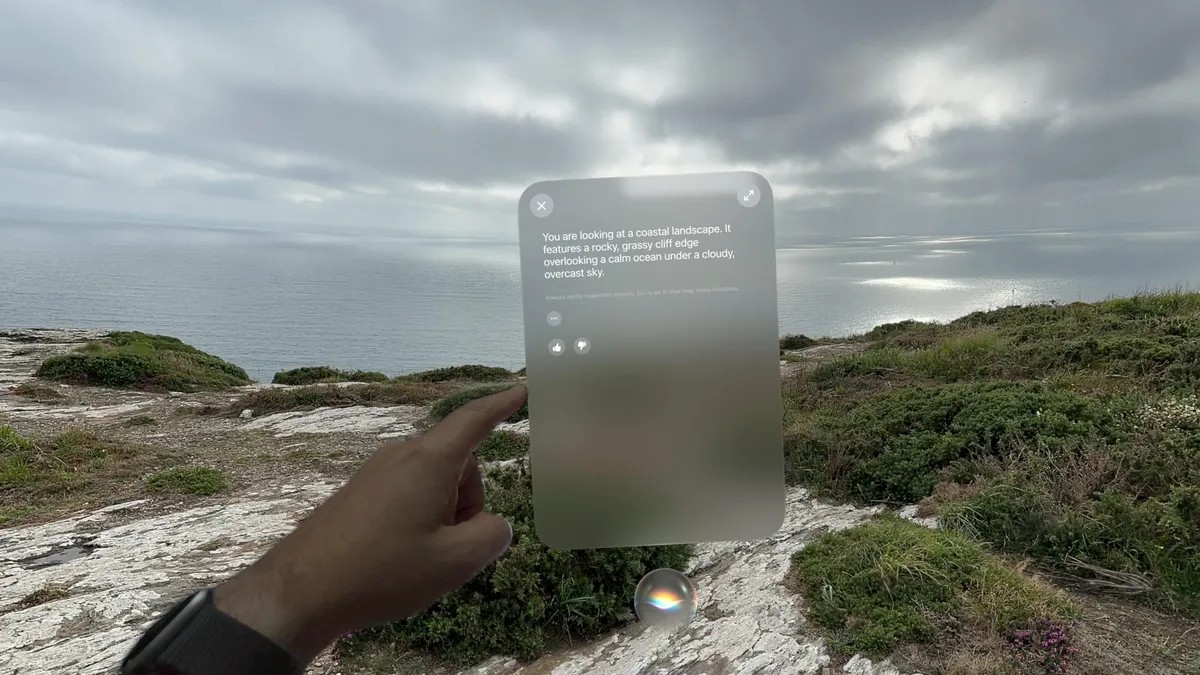
“What is in front of me?”
Siri paused. Then she scanned.
The camera snapped a photo. Real and virtual were mashed together. She read the spines of Uzumaki and Wonderbook. She saw my action figures. She even identified the red Virtual Boy console and the Steam Deck sitting next to them.
Did I expect this to be magic?
I shouldn’t have been surprised. I’ve seen Gemini Live do similar things in Samsung’s XR headset. I’ve asked camera-aware smart glasses to describe my walk through the city. But Apple is different.
This falls into the category of sensory companion. It sees your field of view. It doesn’t care if the data comes from the lens or the render engine.
There is friction, obviously. It is an early preview of VisionOS 27. Siri does not stream live video analysis. She takes one picture per question. A static snap-response. If you move your eyes? She stays on the old capture. You have to drag the orb, close it, and ask again. It feels clunky. It also feels inevitable.
The bigger issue is scope.
Apple is pushing this supercharged Siri across iPhones, iPads, and Watches this fall. But the headset is where the ambition leaks out.
I tested it on my workflow. I opened my Notes app with a voice command. Siri summarized my recent playwriting notes instantly. She looked at the browser windows on my MacBook’s virtual display extension. While writing this sentence, she told me I had a Google Doc open. She knew I was writing about her seeing things that weren’t there.
It’s eerie.
The machine knows where I look, what I read, and what I hide on the shelf.
Then came the photos.
I tried the new panoramic background feature. You take a photo from your library, and Apple’s AI turns it into a 3D environment. Not a flat image. A space.
The result isn’t perfect Gaussian splatting like you get on Meta Quest. There is no ambient sound. The edges still bleed into my actual office walls. It feels like a window, not a room.
But I loaded a picture of my mother’s backyard from the pandemic days. Suddenly, I was standing there.
The tech is rough around the edges. Some photos fail to convert. The lighting feels artificial. But when that photo rendered, my chest tightened.
We are moving toward glasses that see everything. Siri on a Watch today. Siri in your periphery tomorrow. The device matters less than the intent.
We are letting machines memorize our rooms.
The orb is still hovering there, waiting for the next command.