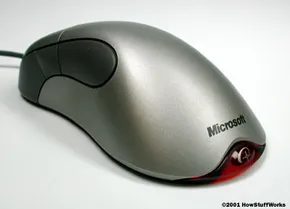
Traditional rollerball mice are basically a thing of the past at this point. Now if you point and click on the screen, you are almost certainly using an optical mouse. This is not just a trend. This is an important hardware standard. But how did a tiny camera in your hand become the main way to interact with computers?
This change happened in late 1999 when Agilent Technologies introduced its latest optical mouse. Until then, we relied on mechanical principles. Now we trust the light.
How the sensor actually works
It sounds like science fiction, but the process is surprisingly simple. Inside the mouse is a small camera. 1500 pictures are taken per second. This is not a typo.
A small red light emitting diode (LED) illuminates the bottom surface of the mouse. The light bounces off the table and mouse pad and hits the complementary metal oxide semiconductor (CMOS) sensor. The sensor records the texture of the surface.
This is where the magic happens. The CMOS sensor sends each image to a digital signal processor (DSP). This chip operates at 18 MIPS, or million instructions per second. DSP analyzes the image. Look for patterns. Check how these patterns have moved from the previous frame.
When the pattern moves to the left, the mouse knows that it is moving to the left. Send the coordinates to your computer. The cursor is moving. This loop happens hundreds of times per second. This is why movements appear soft instead of jerky.
Why you won’t be finding ball mice anymore
机械鼠标有移动部件。 当您移动鼠标时,球会旋转。 那个球与里面的滚轮摩擦。 最终,这些滚筒变脏了。 最终,这个机制崩溃了。
光电鼠标没有移动部件。 没有球。 没有需要清洁的滚筒。 污垢无法进入内部并干扰跟踪。 这意味着磨损更少,故障几率也显着降低。
追踪也更加清晰。 分辨率的提高意味着光标对您的手部动作的响应更加流畅。 您不再需要专门的鼠标垫。 它几乎适用于任何表面。 木材、玻璃、织物、纸张。 它就是有效的。
Old forgotten technology
LED optical mice have only been in use for about 20 years. However, this concept is old. More than ten years ago, another type of optical mouse was introduced.
Early versions used a focused beam. Reflections from a highly reflective mouse pad with dark lines. The beam hits the sensor. You moved the mouse. The lattice blocks the light. The sensor sends a signal. The cursor has moved.
This system is frustrating. The mouse must be held at an exact angle. It will not work if the beam and sensor are misaligned. A mouse is useless without a mouse pad. Replacement pads must be purchased. Very difficult to use.
Current LED-based models are more user-friendly and reliable. No special mouse pads required. No special angle is required. Just work on a messy desk.
Optical equipment FAQ
What is a wireless optical mouse?
The technology inside is the same. Small cameras that can take 1500 pictures per second are still used. The red LED reflects light from the surface onto the CMOS sensor. The difference is that the mouse sends data to your computer via radio frequency or Bluetooth signals instead of a wire. The tracking logic remains unchanged.
Which surface is best for an optical mouse?
Ideally, it should be flat and smooth. Diffusion reactions and opaque surfaces also have an effect. This covers wood, plastic and most fabrics. For uninterrupted precision, a comfortable Mouse Pad is the best choice. Provides a consistent texture from the sensor lock.
Is the light emitted by an optical mouse dangerous?
No. This device uses a CMOS sensor and LED light. These are harmless. These are typically classified as Class 1 devices. Even if you don’t see a particular label, you can assume it’s safe. It’s not a laser in the dangerous sense. It’s just a bright red light.
Why do optical mice use red light?
Red light is reflected better regardless of the ambient lighting conditions. Thanks to this, the sensor detects movements more reliably in different environments. Red diodes are also inexpensive and widely available. Green and blue LEDs came later and are more expensive, but some high-end gaming mice use them for various sensing needs.
Conclusion
Mechanical mice die. Optical mice have become mainstream because they are cheap to make, have a long lifespan, and can be used for almost anything. Early versions required special pads and precise angles. they fail easily.
The current generation uses a simple red LED and a fast sensor. Hand tracking requires thousands of photos per second. The coordinates are sent to your computer. The cursor is moving. It is very quiet. Very reliable. It’s everywhere.
You probably have one right now. You just didn’t notice the camera inside.
See the next page for more information.