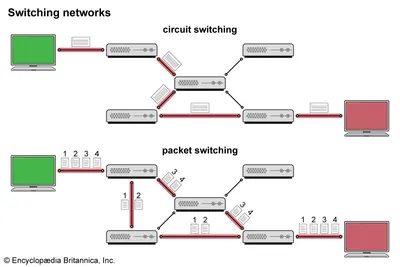
When you send an email or load a webpage, you aren’t sending a single, massive file across the world. You’re sending a fragmented mess. It works because of the packet-switched network, a digital infrastructure that breaks data into smaller chunks called packets. These chunks travel through a series of switches, get routed to their destination, and are then reassembled by the receiving computer. This process is known as store-and-forward.
If the Internet or your local network is down, you’re likely dealing with a failure in this exact mechanism.
Why Packet Switching Beats Circuit Switching
Traditional networks use circuit switching. Think of it like a dedicated phone line. A single physical path is opened with fixed bandwidth, and data flows sequentially down that line until the conversation ends. It holds the path open regardless of whether anyone is talking.
Packet switching is different. It doesn’t care about a single dedicated path. Instead, it directs packets down multiple available routes. Each switch makes a decision based on current network efficiency. If one path is congested or broken, the packets simply reroute.
This design offers two major advantages:
* Optimized channel capacity.
* Improved fault tolerance.
But there is a catch. Packet switching is complicated. It requires significant processing power and large amounts of RAM to manage the routing decisions. It can also introduce delays. Packets might arrive out of order, or some might be lost entirely. Because of this complexity, packet switching is preferred for small files. Circuit switching is still used for large, real-time transfers where latency matters more than efficiency.
The Anatomy of a Data Packet
A packet-switched network has two main components: cores and edges.
The core consists of routers and control systems connected by high-bandwidth channels. The edge is where your device lives. Your host system—your PC, phone, or tablet—sends and receives these packets.
Communication across the core relies on protocols. These are procedures that senders and receivers use to talk effectively. The collective set of protocols is called a protocol stack.
Every packet that crosses the core is a datagram. It has two parts:
1. Header : Control information, including sender and receiver addresses.
2. Payload : The actual data being delivered.
Sometimes, these packets are split even further into smaller units. This is packet fragmentation. It happens when the data is too large for a specific network link to handle in one go.
Connectionless vs. Connection-Oriented Networks
Not all packet networks operate the same way. They generally fall into two categories: connectionless and connection-oriented.
Connectionless networks, also called datagram networks, work as described above. Data is partitioned, headers are attached, and each datagram finds its own best route from source to destination. No prior arrangement is needed.
Connection-oriented networks mimic circuit-switching. They set up a dedicated route between the sender and receiver before any data is transferred. This approach gains the benefits of circuit-switching while staying on a digital network. It’s more structured but less flexible.
The History of Breaking Data Down
The idea didn’t start with the modern Internet. It began with Paul Baran, an engineer at RAND Corporation. In the early 1960s, the U.S. Air Force asked him a chilling question: how could a computer communications network survive a nuclear attack?
Baran proposed “hot-potato routing.” The idea was to break large units of data into smaller blocks. He published his theory in a series of studies between 1960 and 1962. He later expanded it into an 11-volume analysis titled On Distributed Communications in August 1964.
The government and private corporations ignored him. They weren’t interested in distributed communications yet.
Independently, Donald Davies, a computer scientist at the UK’s National Physical Laboratory, arrived at the same concept. He started building a network to test the idea. Baran called his units “message blocks.” Davies called them “packets.”
The term stuck because of Lawrence Roberts. Roberts was a manager at ARPA (now DARPA). In October 1967, at a symposium in Gatlinburg, Tennessee, he learned of Davies’s work. Roberts adopted the term packet switching for ARPANET. That project would eventually evolve into the Internet we know today.
“Packet switching is therefore preferred for transmitting relatively small files, while circuit switching is still used for larger transfers.”
The legacy of those early engineers is still in your browser tabs. Every time you stream a video or download a file, you’re relying on the store-and-forward logic that Baran and Davies dreamed up to survive the end of the world. Or at least, to keep your Netflix from buffering when the server gets busy.
The Cold War of Packet Switching
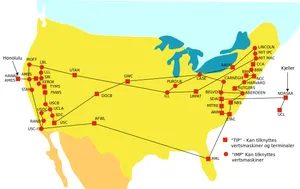
The early days of ARPANET were defined by a quiet revolution. Bolt Beranek and Newman, known as BBN, built the infrastructure in just a year. They took the abstract concepts of Paul Baran and Donald Davies and made them work. The first successful test happened in October 1969. It wasn’t flashy. It connected four nodes: UCLA, Stanford Research Institute, UCSB, and the University of Utah. By 1975, that number had grown to 57.
Public interest, however, was tepid. When ARPANET was showcased at the International Conference on Computer Communications in October 1972, the reaction was underwhelming. The U.S. communications industry didn’t see the point. Some were hostile. Others just didn’t care.
BBN and Robert Kahn saw an opening. They founded Telenet, a commercial packet-switched network. The idea was simple. If the big telecoms wouldn’t build it, a private company would.
Global Skepticism and National Projects
The U.S. wasn’t alone in experimenting with packet switching. Other countries moved faster. In November 1973, the French postal service announced TRANSPAC. The Trans-Canada Telephone System followed with DATAPAC in October 1974. Japan’s NTT had plans too.
Most providers stayed on the sidelines. They watched. They waited. They wanted to see if these early networks would crash or survive.
While governments built their own isolated systems, researchers were refining the core technology. Colin Davies finished the Mark II network in 1973. It influenced the UK and much of Europe. Louis Pouzin finished CYCLADES that same year.
“Pouzin’s CYCLADES network made hosts, rather than network cores, responsible for error correction.”
This shift was critical. It decentralized control. It put the burden of reliability on the computers themselves, not the infrastructure.
Standardizing the Chaos
Five nations led the charge: Canada, France, Japan, the UK, and the U.S. They faced a fragmentation problem. Each network used different rules. They couldn’t talk to each other.
Talks began in 1975. The goal was a standard host-network interface. The result was CCITT Recommendation X.25. Adopted in March 1976, it unified these disparate systems. It marked the rise of interconnected public service networks.
X.75 followed shortly after. It standardized how international networks connected. This was the precursor to the global web we use today. But it wasn’t enough.
The TCP/IP Breakthrough
By 1979, Bob Kahn led DARPA’s Information Processing Techniques Office. The U.S. Department of Defense had multiple packet-switched networks. None were compatible. This was a strategic weakness.
Kahn solved it. He pushed for TCP/IP. This protocol standard had been imagined in a 1974 paper written with Vincent Cerf. It was designed to connect incompatible networks.
DARPA adopted it. Other research labs followed. The public eventually used it. TCP/IP became the foundation of the Internet.
It wasn’t inevitable. It was a choice. A choice made when no one else was looking.