
Real world assets (RWA) represent a shift in thinking about value. It’s not just a buzzword. This is the “tokenization” of physical or traditional financial assets using blockchain technology. We’re talking stocks, real estate, art and commodities. The goal is simple. It’s about making management easier for everyone, not just the institutional players.
Consider gold. Traditionally, buying gold has been a headache. You have to deal with dealers, pay storage fees and go through complex verification. However, with DeFiChain, this process changes. You can buy gold tokens directly from your cryptocurrency wallet. You can pay with USDT, a stablecoin that tracks the US dollar. It only takes a few minutes to complete the transaction.
Why fractional ownership is important
DeFiChain’s RWA model enables certain tokenized assets. You will find tokens like dTSLA, dAMZN, dAAPL, etc. They do not represent direct legal ownership of shares in the traditional sense. These mimic the price movements of Tesla, Amazon and Apple shares.
This creates a unique opportunity.
Any user can buy some Apple shares without opening a brokerage account. they can hold it. they can sell it. They can pocket the profits. They never technically, they have never been shareholder in the corporate registry of the company. Blockchain records everything. All trades are permanent and public. Transparency replaces the traditional financial black box.
Execution speed
Why is this important? Because speed is currency.
In the traditional market, settling a trade takes days. In the RWA market, settlement can be instant. This eliminates friction. It removes gatekeepers. This allows retail investors to participate in high-value assets with little capital.
Is this the future of investing?
The structure is definitely different. Barriers to entry are lower. Better liquidity. Changes in the risk profile. But the core benefit remains. Access. For the first time, tokenized assets offer everyday users a way to participate in large financial products without bureaucratic overhead. The ledger does not lie. The transaction is visible. Administration is transferred from organizations to individuals.
This concept is not new. Real World Assets (RWA) have been around the cryptocurrency world for several years. But in March 2024, everything changed.
BlackRock launched its BUIDL fund. This is more than just a product drop. It was a validation. The fund tokenizes US Treasury bills. This moved billions of dollars from traditional finance to the blockchain ecosystem almost overnight.
The numbers tell the story. RWA investments will total $5 billion in early 2024, and this figure is expected to rise to $15 billion by early 2025. Three times the value in a single year.
Larry Fink, BlackRock’s CEO, isn’t hiding his excitement. He believes the market is about to reach $10 trillion. This number seems exaggerated until you look at the assets. Real estate. Private credit. Government bonds. These are not speculative tokens. They are backed by cash flow and collateral.
Sergey Nazarov, co-founder of Chainlink, put it more bluntly. He predicts that by 2030, RWA will exceed the combined value of all cryptocurrencies. The logic is simple. Cryptocurrency offers speed and accessibility. RWA offers yield and stability. Together, they solve the liquidity problem that has plagued decentralized finance for a decade.
Why Ethereum Dominates the RWA Space
Not all blockchains are built for institutional-level asset tokenization. Ethereum remains the clear leader in the RWA market.
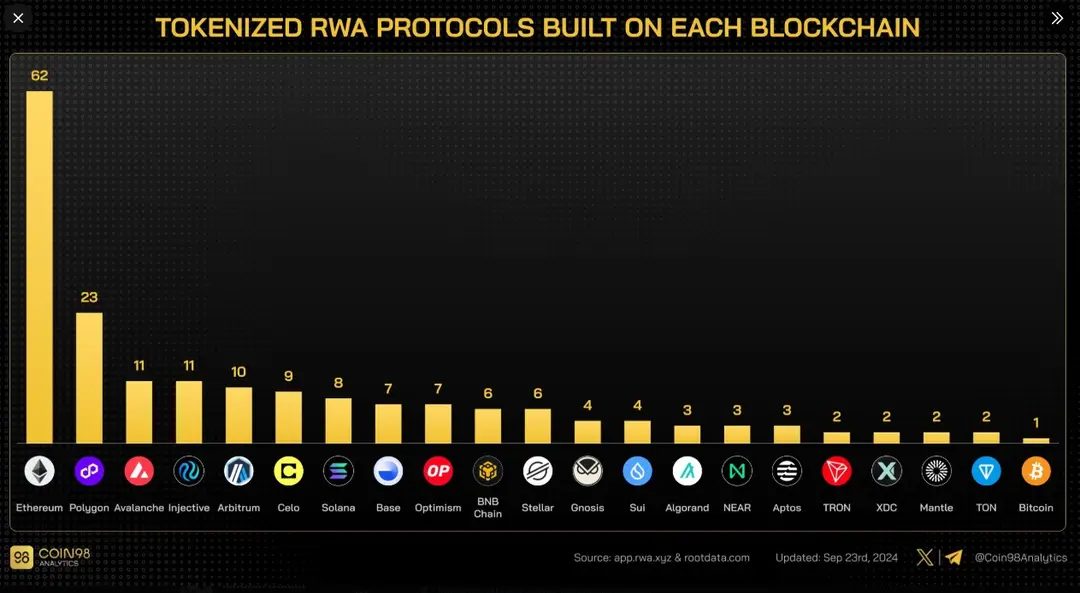
According to data published by Coin98 in September 2024, Ethereum hosts 62 percent of all active RWA projects. This is not just a matter of network effects. This is related to security, liquidity depth and developer maturity. When institutions move billions of dollars, they’re not betting on an experimental chain. They go where the infrastructure is proven.
Polygon follows with 23%. Avalanche holds 11%. Injective also sits at 11%, while Arbitrum captures 10%.
Bitcoin? It takes only 1% of RWA space.
This is not a failure of Bitcoin. This is a design limitation. Bitcoin’s scripting language is intentionally limited. Prioritize security over complexity. Tokenization of complex financial products requires smart contracts. Ethereum delivers that. Bitcoin does not.
The Infrastructure Behind the Assets
The increase in RWA is not just about where the property is located. You can check them as follows:
This is where the oracle comes into play. Chainlink’s price offering and reserve verification protocols are important to RWA. These bridge the gap between off-chain data and on-chain payments. Without a reliable data source, tokenized assets are just digital debt instruments that cannot prove the existence of an underlying value.
BlackRock’s entry indicates that the technical barrier has been removed. Regulatory frameworks are still evolving, but the market is changing faster than policymakers can react. Institutional investors want access to physical assets without leaving the blockchain. They want yield without counterparty risk.
The $15 billion figure is just the beginning. If RWA reaches $10 trillion as expected, Ethereum’s dominance may change. New chains optimized for compliance and privacy may become popular. Or maybe the incumbents will adapt.
One thing is certain. The boundaries between traditional finance and cryptocurrencies are blurring. And it happens in a chain.
The hidden costs of convenience
We believe you can save time by having AI draft for you. You don’t. You outsource your voice. And the algorithm doesn’t care about your nuances. It cares about completion.
The real danger is not that machines will replace us. Instead, we replace ourselves with mediocrity.
Do you remember the last time you used Smart Search? Did you get an answer or did it just feel like a summary of the answer? There is a difference. One builds knowledge. The other builds dependencies.
We have passed the era of simple automation. We live in an era of augmentation that looks like replacement. And it’s slippery.
When the tool starts thinking for you
Most people don’t realize that software is making decisions for them. The feeds you see on social media. Products recommended on online shopping sites. Traffic routes suggested by navigation applications.
None of these are neutral. They are optimized.
Why? Engagement. speed. profit.
Not your well-being. It’s not your privacy. Not your long term memory.
“This tool is neutral. Its design purpose is not.”
When AI writes code, you don’t see the logic gaps You don’t see the security vulnerabilities hidden in the efficient syntax You can see it working. This is a trap.
Efficiency is a seductive liar.
Skills erosion
This is the part no one wants to admit. We are getting worse at basic tasks.
Writing? Worse.
coding? Worse.
Navigation? Worse.
Critical thinking? Worse.
Why learn navigation when GPS can tell you exactly where to turn? Why learn how to debug before you finish typing the question when Stack Overflow already has the answer?
This is not just laziness. This is a fundamental change in the way we process information. We have delegated the cognitive load to machines. Now we can be surprised when our brain feels slow.
It’s not sluggish. It’s atrophied.
The illusion of control
You think you’re in control because you can turn the app off
It’s an illusion.
Habits have been formed. The expectation is already set. Once you’ve experienced the comfort of being frictionless, friction can feel like a failure.
“Difficulty” has been redefined as “inefficiency”.
However, it can also be difficult. Learning is hard. Creating is hard, isn’t it? It’s hard to remember.
There is value here. In the delay. In the effort.
What’s left?
What should you do?
Do you want to remove all apps? No, that’s unrealistic. And probably ineffective.
We must be intentional. We need to demand more from our tools. And less from our machines.
Use AI to brainstorm instead of for finalizing.
Use your GPS in unfamiliar places instead of familiar ones.
Use search for verification, not understand.
The goal is not to reject technology. This is about taking back our agency.
Otherwise, the next time you try to write an email. You won’t know how to start. You’re just staring at a blank cursor.
Waiting.
For something to write for you.