It hides jets. It hides drones.
And it was made in Lisbon.
A team from GTechPlasma — a spin-off of the Plasma and Nuclear Fusion institute at Instituto Superior Técnico — has developed a way to print high-quality graphene using plasma technology. The result? A material that swallows electromagnetic radiation for breakfast.
Bruno Soares Gonçalves, the company’s co-founder, calls it “extremely interesting” for radar-absorbing coatings. Most countries keep this stuff locked down. Tightly. But not us.
“At present, there is no other solution is in Europe, and even worldwide, only the US has one… the material that coats the F-35 cannot be exported. So, we have a material ‘made in’ Portugal with strong application potential.”
That sentence matters. Let it sink in. While Europe looks at US fingers for stealth tech, Portuguese labs are baking their own atomic shields.
How thin can carbon get?
One atom thick. That is graphene.
Usually, we extract it or synthesize it clumsily. This team uses precursors like ethanol or methane and blasts them with plasma. They control the process at the atomic level. Why bother with that precision?
Because you want specific results.
If you want to absorb radar, you tweak the atoms one way. Need to store hydrogen? Tweak them another way. Separate uranium from rare earths? Done.
“That is what we are able do with our device which is patented in US, Japan, and Europe.”
Patents aside, let’s talk warplanes.
The estimate for a fighter jet covered in this stuff is startling. An F-16, once loud and blindingly visible to enemy radar, would suddenly have the same signature as a bird. A sparrow. A pigeon.
Imagine being an air defense operator.
Is that a bird flapping its wings? Or is it a 20-ton aluminum tube filled with missiles flying 600km/h overhead? You might miss it. Or worse — you see it too late to matter. That delay is a military advantage. Sometimes the only advantage you need.
From powder to paint
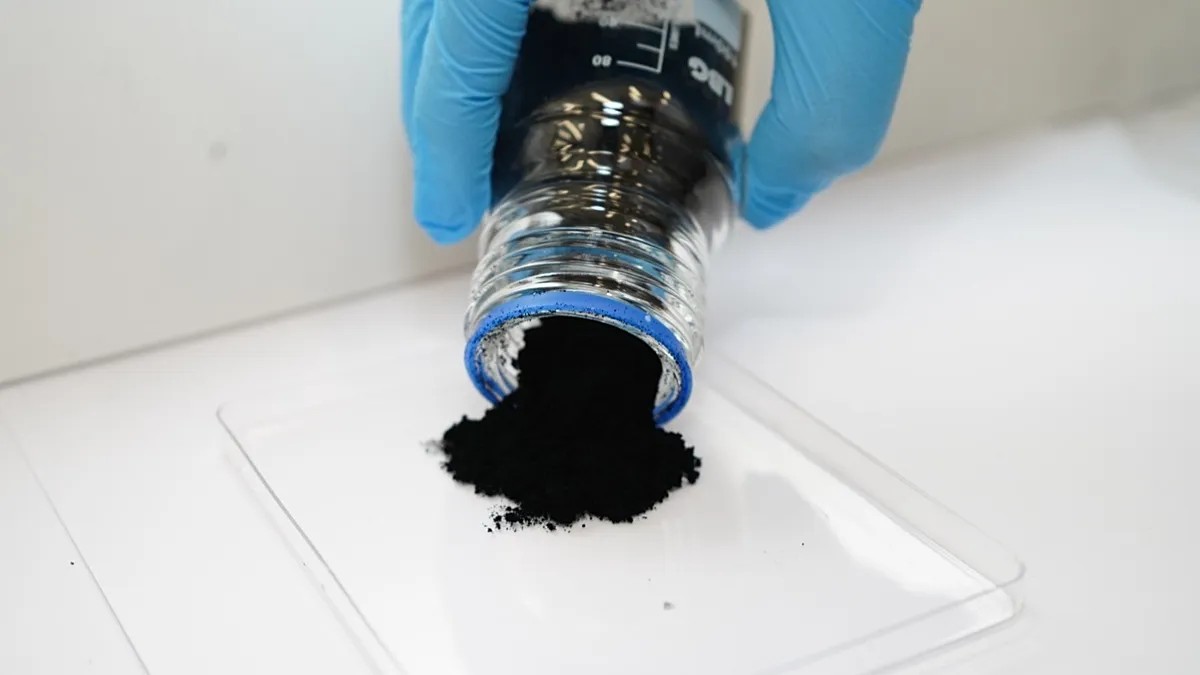
Currently, the output looks like soot. A light black powder.
It isn’t quite ready for a factory floor yet — at least, not entirely. GTechPlasma produces about 40 milligrams per minute of high-quality material. Small scale. Precise.
They aren’t staying small though.
Their industrial partner, Plasmaphene, based in Vila Viçosa and funded by Compete 2020, is stepping in. The goal: multiple machines running in parallel. Not for redundancy necessarily, but for variety. The machine acts as a platform. Change the recipe. Get a new material.
It’s flexible. Adaptable.
They’ve already supplied 260 grammes to a Portuguese drone maker. Next stop: coatings. Ready-to-apply paints that end users can slap on their own airframes without needing a chemistry PhD to figure out integration.
“The goal is to provide solution are as close as possible to somthing client can apply instead of supply just powder…”
Why does any of this matter beyond keeping aircraft hidden?
Electromagnetic shielding. Radiation reduction. Energy storage.
Portugal just carved out a niche in a field dominated by two superpowers. They built it atom by atom. The factories are getting ready. The partners are lining up.
Will the sky change soon?