Most people associate home theater with a massive wall of speakers and a subwoofer that rattles the floorboards. It is the classic cinematic experience. But let’s be honest. Not everyone has the square footage for a full 5.1 setup. Many renters just want to watch Netflix without turning their living room into a cable-strewn jungle. You don’t need a dedicated media room to get that immersive feel. You just need virtual surround sound.
This technology mimics the spatial effects of a multi-speaker array using significantly fewer components. You aren’t buying a new set of walls. You are buying a specific type of audio processing.
There are two main flavors of this tech. The first is the 2.1 surround system. This usually means two front speakers and a separate subwoofer. That’s it. Despite the name implying simplicity, these systems are designed to trick your brain into hearing the full surround-sound experience of a five-speaker setup. The second variety is digital sound projection. These tend to use a single strip of small speakers. They often lack a dedicated subwoofer, relying on the strip itself to project audio across the room.
Regardless of the hardware, the goal is the same. The system modifies sound waves so they appear to originate from locations where no physical speaker exists. This isn’t magic. It is psychoacoustics. We are talking about how humans perceive sound. By understanding the quirks of human hearing, engineers can make two speakers sound like five.
How Your Brain Maps Space
To understand why this works, you have to look at the hardware of your own head. A speaker is essentially a machine that converts electrical impulses into physical movement. It uses a diaphragm. This cone moves rapidly back and forth. When it pushes out, it creates compression. This is an area of high pressure in the air. When it pulls back, it creates rarefaction. This is lower pressure.
These compressions and rarefactions travel through the air as a longitudinal wave. They are driven by the movement of air particles. When particles push against each other, pressure rises. When they pull apart, pressure drops. This wave eventually hits your ear.
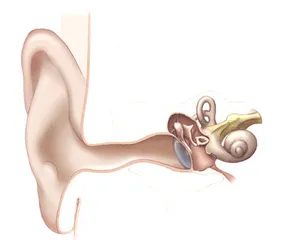
It hits the pinna, also known as the auricle. This is the external cone of your ear. The sound then travels down the ear canal. It physically moves your tympanic membrane, or eardrum. This triggers a chain reaction of tiny structures inside. Eventually, vibrations reach the cochlear nerve. The nerve sends these impulses to your brain. Your brain interprets them as sound.
But hearing isn’t just about detecting volume or pitch. Your brain uses the sound to locate its source. This happens via aural cues. You might not consciously think about it, but your brain is constantly calculating where a sound is coming from. It is an evolutionary survival skill. Animals use it to find food or avoid predators. Humans use it to determine if a knock is at their door or their neighbor’s. If you can locate the source, you can react.
Virtual surround systems exploit these cues. They alter the sound waves so your brain receives conflicting or modified data. The result is a phantom image. You hear sound coming from behind you, even though the speaker is in front of you.
The Dolby Algorithm Approach
One of the most well-known methods for creating this environment is Dolby Virtual Speaker. It is not a physical device. It is a set of rules and algorithms. These rules re-create multi-channel sound for devices that only have two ordinary speakers.
You will find this technology baked into certain TVs, stereo systems, and computers. It processes the audio signal before it hits the driver. The algorithm manipulates the timing and frequency of the sound waves. It tricks the brain’s localization cues. The effect is similar to Dolby Headphone. That technology uses sound-processing algorithms to let normal headphones mimic a surround-sound speaker setup.
This approach removes the need for complex wiring. You don’t need to drill holes in walls. You don’t need to measure distances between speakers. The processing happens digitally. The hardware just needs to be able to output a stereo signal.
It raises a simple question. Why fight physics when you can just trick the brain?
The mechanics of hearing direction
You are in a silent exam hall. The air is still. Then, a coin drops.
Your head snaps toward the sound. It happens so fast you don’t think about it. It is instinct. Your brain calculates the source in a split second. You might only have hearing in one ear. It still works. How?
The brain is a processing engine. It takes raw data from the ears and runs complex analytics. There are two main inputs. One is the difference between what the right ear hears versus the left. The other is how sound waves bounce off your head and body. These are the aural cues. The brain uses them to triangulate location.
Think about the coin again. It hits the floor to your right.
Sound travels as physical waves. It moves at a finite speed. This takes time. The wave hits your right ear first. A fraction of a second later, it hits your left.
There is also a volume drop. The sound is quieter in the left ear. Why? The wave dissipates naturally. Your head absorbs some of it. It reflects some. This creates a gap.
This gap has a name. It is the interaural level difference (ILD).
The time gap is another name. It is the interaural time difference (ITD).
These two metrics give your brain a clear picture. Is the sound left or right? The answer is usually yes.
But elevation? That is tricky.
If a sound is above you or below you, the path to your ears changes. The path length varies. But the difference between left and right ears stays the same. The ILD and ITD do not change with height. So your brain struggles.
Front or back is even harder.
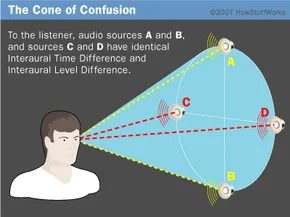
If you rely only on time and level differences, you can get confused. A sound behind you can produce the exact same ILD and ITD as a sound in front of you. The data points match. The location does not.
This creates a problem zone. It is a cone-shaped area extending outward from your ear. We call it the cone of confusion.
Inside that cone, the numbers are identical. Your brain cannot distinguish front from back using time and volume alone.
This assumes you have two working ears. What if you do not?
If you have hearing in only one ear, you can still localize sound. The brain adapts. It looks at reflections. It analyzes how sound bounces off surfaces in that single ear. It is not perfect. But it works.
When a sound wave hits you, it doesn’t just bounce off your eardrum. It hits your head. It hits your shoulders. It wraps around the curved shell of your outer ear. Each reflection subtly alters the wave. These reflections interfere with one another. Parts of the wave get bigger. Parts get smaller. This changes volume and quality.
These changes are known as head-related transfer functions (HRTFs).
Unlike Interaural Level Differences (ILDs) or Interaural Time Differences (ITDs), HRTFs handle elevation. They tell you if a sound is coming from above or below. They also distinguish front from back. The brain reads these wave distortions to pinpoint origin.
Why We Can’t Measure HRTFs by Ear
The human auricle is a maze. It has countless surfaces. Most are curved. Sound bounces off one surface, hits another, and bounces again before reaching the tympanic membrane.
Add the face. The head. The hair. The torso.
Trying to manually isolate these reflections is nearly impossible. The interactions are too complex. Scientists needed data. Lots of it.
They used sound sources. They used arrays of microphones. They used computer programs.
The Role of KEMAR in HRTF Research
Researchers didn’t just guess. They measured.
In some studies, they attached tiny microphones directly to human participants’ bodies. In others, they used lifelike mannequins. These mannequins mimic human skin, cartilage, and proportions.
The most famous is the Knowles Electronic Manikin for Acoustic Research (KEMAR). It has been a staple in labs like the MIT Media Lab.
Why mannequins? Because every head is different. Every ear shape is unique. To create a universal model, you need standardization. KEMAR provides that baseline.
HRTFs are essentially a fingerprint for how your body filters sound. Without them, audio lacks depth.
From Measurement to Algorithm
The microphones have one job: capture sound.
Computers then analyze the differences. They look at how a single sound interacts with different body parts. They track sounds from different points of origin.
This data leads to an algorithm.
An algorithm here is just a set of rules. It describes how HRTFs and other factors changed the shape of the sound wave. If you apply this algorithm to a new sound wave, it changes that wave’s shape. It gives it the same properties the original wave had after interacting with a body.
This is the engine behind virtual surround-sound.
How Virtual Surround Works
Here is what happens when you put on headphones that claim to mimic a 5.1 surround system.
- Capture: Researchers use microphones to record sound from a physical 5.1-speaker setup. They record from ears and bodies of various shapes and sizes. This accounts for individual perception differences.
- Model: Using computers, they develop an algorithm. This algorithm replicates the spatial characteristics of that real-world sound field.
- Apply: The algorithm is applied to a two-speaker (stereo) system. It reshapes the audio. The result is a sound field that mimics the shape of a real 5.1-channel setup.
You are hearing a simulation. Your brain processes the HRTF-altered audio as if the sounds are coming from specific directions in space.
It’s not magic. It’s math. And it’s why a movie feels immersive even when you’re alone in a room.

Virtual Surround Sound Tools and Techniques
It’s a trick. A sophisticated, digital sleight of hand. The processor takes your standard stereo signal and warps it with aural cues. Phase shifts. Frequency dampening. Delay lines. It forces your brain to accept a lie: that the audio is exploding from five distinct points in space rather than just two speakers left and right. You’re not hearing more. You’re being convinced you are.
This is the core promise of virtual surround sound tools. They don’t add hardware. They add deception.
The DSP Approach: Shaping the Signal
Most consumer-grade setups rely on Digital Signal Processing (DSP). This isn’t magic; it’s math applied to sound waves. The software analyzes the incoming stereo track and applies Head-Related Transfer Functions (HRTFs). These functions model how your ears and head filter sound from different directions.
By artificially altering the timing and intensity of frequencies between the left and right channels, the system creates “phantom images.” Your auditory cortex fills in the gaps. It places a sound behind you or to your side based on subtle cues your brain has evolved to trust.
Hardware vs. Software Solutions
You have options. They differ in efficacy and cost.
- Software-based virtualization: This runs on your PC, console, or smartphone. Apps like Dolby Atmos for Headphones or Sony’s 360 Reality Audio take a 5.1 or 7.1 mix and down-convert it. It’s convenient. But it often sounds thin. The HRTF profiles are generic. They assume an average head shape. If your head isn’t average, the illusion breaks.
- Hardware-based upmixing: Some AV receivers and high-end soundbars do this internally. They process the signal before it hits the speakers. A 5.1 setup can simulate a 7.1 or even 9.1 experience by using the rear speakers and height channels to fill the void. It’s less dependent on HRTF accuracy since you’re using actual physical speakers.
- Ambisonic formats: This is where it gets technical. Ambisonics captures sound as a sphere. It records the directional information directly. When played back through virtual surround tools, the panning is more accurate. It’s used in VR headsets mostly. If you’re just watching a movie on a couch, you probably won’t notice the difference.
Why It Matters for Everyday Users
You don’t need a theater. You need immersion.
The problem with stereo is that it’s flat. Everything happens in front of you. Action movies lose their spatial depth. Music loses its width. Virtual surround sound fixes that by expanding the soundstage. It’s not true surround. It’s a convincing approximation.
For gamers, it’s critical. Directional audio can mean the difference between spotting an enemy behind a wall and getting flanked. The cues must be precise. A poorly tuned HRTF can mask footsteps entirely.
Where It Fails
The illusion is fragile.
- Head movement: If you turn your head, the sound stays fixed to the speakers. It doesn’t rotate with you. This breaks the spatial illusion instantly.
- Ear shape: Everyone’s pinnae are different. The filters used in most software are averages. If your ears catch high frequencies differently,
The Mechanics of Fake Surround Sound
Virtual surround systems don’t just rely on physics; they hack your brain. While real 5.1 setups use actual speakers to bounce waves around a room, digital sound-processing systems try to trick you into hearing space. They reflect sound waves off your walls. If a wave bounces off the wall behind your head, your brain registers it as coming from behind you.
This requires precision. You must provide the room’s dimensions or use a calibration microphone. Miss the angle? The illusion breaks.
Cancellation and Interference
Many two-speaker setups use crosstalk cancellation. This is a creative application of destructive interference. The goal is simple: stop your left ear from hearing the right channel’s audio.
If your ears pick up each other’s cues, the stereo image collapses. The system uses algorithms to eliminate that unwanted bleed. It’s not magic. It’s signal processing.
The Processing Power Behind the Sound
These algorithms need muscle. A computer processor, usually inside a receiver or amplifier, handles the heavy lifting. This chip processes sound waves in real time. It takes input from a DVD player or satellite box. It applies the math. It adjusts volume. Then it sends the clean signal to the speakers. Some systems hide this hardware inside the speaker units themselves.
The Sweet Spot Problem
Here is the catch. The immersion is an illusion. It only works if you sit in the right spot. You must look directly at the screen.
Move left or right of the sweet spot and the effect vanishes. You fall outside the directed sound field. Sounds panning across the room might stutter or sound unnatural. You are hearing two speakers pretending to be five. The result lacks the physical power of a full surround array.
Shopping Considerations
Before you buy, check these factors.
- Room size and shape: Digital sound projection relies on reflections. It fails in huge, open spaces or rooms with irregular walls.
- Desired effect: Want room-filling audio? A two-speaker system might disappoint.
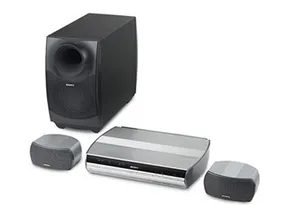
- Subwoofer: 2.1 systems include one. Many digital projection systems do not. You can add one for bass, but it costs extra.
- Setup requirements: Some systems are plug-and-play. Others demand you measure the room and run a calibration routine.
- Price: Affordable 2.1 systems exist. High-end digital projection units can exceed $1500.
The tech is impressive until you stand up. Then it’s just echoes.
Where to dig deeper into audio science
If you want to move beyond the basics and see exactly how sound waves bounce off walls, or how headphones trick your brain into hearing a cinema, the path is littered with resources. Start with the foundational guides. How Home Theater Works sets the stage. Then you need to understand the hardware. How Speakers Work explains the mechanics. How Movie Sound Works dives into the mix.
There are weird, wonderful edges to this field too. How LRAD Works covers long-range acoustic devices. How Acoustic Levitation Works sounds like sci-fi but is real physics. And for the screen, How Televisions Work is just the beginning. You have to look at the panels. How DLP Sets Work. How Plasma Displays Work. How LCD Works. And if you’re feeling nostalgic or just curious about dead tech, How SED-TV Works is a fascinating detour. Then there’s How HDTV Works to tie it all to high definition.
But the real meat is in the comparisons. Popular Mechanics has a solid piece on Multi-Speaker vs. Virtual Surround. It cuts through the marketing hype. You want the hard data? Go to the Institute of Sound and Vibration Research. They don’t sell anything. They just study vibration. Michigan State has a strong focus on Acoustics/Psychoacoustics. It’s where psychology meets physics. And for the nerds who want the math, look up Sound Localization Using Head Transfer Functions.
The research behind the illusion
This isn’t just opinion. It’s measured.
“The brain doesn’t hear speakers. It hears a scene.”
The science relies on specific measurements. Burkhead’s Manikin Measurements from Industrial Research Products, Inc. provide the raw data. You can still find the PDF. It shows how sound hits a dummy head. It’s precise.
Then there’s the cognitive side. Coppin’s work at Rice University on Sound Localization Using Head Transfer Functions proves that our brain uses subtle timing differences to place sound in 3D space. It’s not magic. It’s geometry and delay.
Dolby has been playing with this for years. Their Dolby Headphone technology is designed specifically for stereo headphones. It simulates surround. It creates width. Their Dolby Virtual Speaker does something similar but for home theater setups without the back speakers. It’s a compromise.
Ivo Eames at Sound on Sound broke down How Does Virtual Surround Work back in 2004. He didn’t mince words. He explained the filter banks. The psychoacoustic masking. It’s complex.
John Falcone at Cnet asked the consumer question: Is Virtual Surround Worth It?. The answer is never a simple yes. It depends on the source material.
Head-related Transfer Functions (HRTFs) are the key. The University of Miami maintains a good primer. It explains why some people hear surround and others just hear “muffled.” Your ears are unique. Your head shape matters.
The Institute of Sound and Vibration Research in Southampton has archives that go back decades. If you want to understand why a movie feels “big,” look there.
Christian Koebel at GotFrag Hardware covered Virtual Surround Sound in 2006. He looked at the hardware implementations. The cheap ones. The expensive ones. The difference is in the processing power.
Jack M. Loomis defined Psychoacoustics for AccessScience. It’s the study of perception. Not just the ear. The brain.
Michigan State ’s page on Localization of Sound Sources is a quick read. It’s clear. It’s accurate.
SRS Labs pushed TruSound XT Technology. They claimed to turn stereo into surround. It was controversial. It worked, but it colored the sound.
Eric Taub in the New York Times wrote The Sweet Deception of Virtual Sound. He called it a trick. He was right. But it’s a useful trick.
Vann’s offered a guide on Getting 5.1 Surround from Two Speakers. It’s about placement.