High-definition televisions are dominating electronics store shelves. Standard definition sets are dying out. But if you think this technology is a modern invention born from Silicon Valley or recent consumer demand, you are wrong. The concept is over three decades old in practice, even if it only became a household staple in the US about ten years ago.
The story doesn’t start in America. It starts in Japan.
By the late 1960s, the world viewed Japan primarily as a manufacturer of cheap consumer electronics. That perception was changing fast. Japanese companies and the government poured massive resources into genuine technological innovation. One major focus was television broadcasting. The goal was simple: create a new broadcast standard that would force consumers to buy expensive, high-end sets.
Enter NHK, the Japan Broadcasting Corporation.
In 1968, NHK decided to build a better TV signal. They didn’t wait around. By the 1970s, their engineers had developed the MUSE high-definition system. This was an analog signal designed to pack significantly more visual information than traditional broadcasts.
Panasonic stepped up to build the hardware. In 1974, they unveiled a prototype television capable of displaying 1,125 lines of pixels. Compare that to the 480 lines of standard-definition TV and you see the leap. This was not a minor upgrade. It was a fundamental restructuring of how images were transmitted.
NHK didn’t keep this to themselves. By the 1980s, the technology was mature enough to seek global partners. The logic was sound. If the world adopted NHK’s standards, Japanese manufacturers would control the market for high-end televisions. They could make a fortune.
But the US had other plans.
The adoption of HDTV in America was not inevitable. It was fought over. The path to US high-definition television was blocked by a political and industrial tug-of-war. Broadcasters were fighting against companies invested in two-way radio communications. The interference issues were real. The lobbying was fierce.
Without that specific conflict, the timeline might have changed completely. Or HDTV might never have made it to American living rooms in the form we know it today.
The Race to HDTV in the United States
The early 1980s saw a brutal turf war over American airwaves. On one side, the National Association of Broadcasters (NAB). On the other, Land Mobile, a lobbying group backed by Motorola. Their goal was simple: grab unused TV frequency bands for two-way radio communications. The NAB fought back hard. They claimed these radio signals would interfere with existing broadcasts.
But the NAB was losing ground. The FCC was leaning toward Land Mobile’s argument that unused spectrum was just wasted money. Enter John Abel, the NAB president. He needed a trump card.
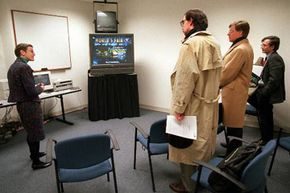
Abel pointed to HDTV. He argued that if the FCC gave those frequencies away now, the US might never catch up to high-definition broadcasting. To prove his point, he orchestrated a demonstration of NHK’s Japanese HDTV technology in Washington, D.C. in 1987.
FCC Commissioner Mark Fowler refused to watch it. Some politicians did. They were stunned. The technology worked. But there was a catch.
If the US adopted the Japanese standard, American TV manufacturers would be permanently locked out of the market, forced to play catch-up to Japanese tech.
Lawmakers refused to let that happen. They wanted HDTV, but on American terms.
The Race for a New Standard
This fear sparked the creation of the Advisory Committee on Advanced Television Service (ACATS). The committee set two hard rules for any new standard:
– It had to be analog.
– It had to remain compatible with existing TV sets.
Twenty-three companies submitted proposals. ACATS whittled that down to six finalists. Each group had to build a working system by 1991 and pay a $200,000 entrance fee. The pressure was on.
During development, something shifted. The committee had initially dismissed digital TV as unfeasible. But as they studied the data, the reality became clear: digital was the future of terrestrial transmission.
ACATS tested all six proposals in a specialized facility. The results were decisive. Analog methods failed. Digital was superior.
Two analog proposals, including NHK’s, were dropped immediately. The four digital contenders remained. But no single winner emerged.
The Grand Alliance
The remaining groups hated the idea of another costly testing round. So they did something unprecedented. They stopped competing. They merged their technologies into a consortium called the Grand Alliance.
This wasn’t just a merger; it was a forced collaboration. The alliance included heavy hitters like General Instruments, Zenith, Philips, and AT&T. They split the work. One company handled the video compression. Another tackled the audio. Another built the transmission system.
They built a prototype HDTV machine piece by piece. ACATS approved the hybrid standard. The path was clear for manufacturers to start producing consumer sets.
The first HDTVs hit the market in 1998.
These weren’t pretty. They were wide. The old 4:3 aspect ratio was gone. The new standard used 16:9. If you bought one, you paid dearly. The price tag started at $7,000.
And for what? Almost nothing to watch.
Content was scarce. Cable and satellite companies hadn’t yet committed to high-definition feeds. If you dropped $7,000 on a giant screen in 1998, you were staring at a blank, expensive black void.
Why It Matters Today
That painful beginning forced a massive shift. The push for HDTV standards accelerated the US transition from analog to digital signals. It laid the groundwork for the streaming era we live in now.
The resolution we take for granted today—1,080 lines of pixels—wasn’t an accident. It was the result of a political battle, a technological gamble, and a consortium of companies that realized they couldn’t win alone.
The standard set in that era defined the screen in your living room. And it’s still dictating how we watch TV.
Digging Deeper Into HDTV History
If you are still trying to wrap your head around why your old CRT television looks like a relic in comparison, these resources will help. The history isn’t just about bigger screens; it is about a complete overhaul of how signal data is handled.
Essential Reading for the Curious
You do not need to be an engineer to appreciate the shift. The following articles break down the mechanics without drowning you in jargon.
- How HDTV Works : A foundational look at the pixel structure and refresh rates.
- Ultimate HDTV Quiz : Test your knowledge if you think you know everything about widescreen formats.
- Fact or Fiction: HDTV : Separating marketing hype from actual technological capability.
- How Home Theater Works : Because the TV is only half the equation. The audio system matters just as much.
- How to Get the Most From Your HDTV : Practical tips for calibration and source selection.
- How Ultra-high Definition Works : The logical successor to HD.
- 10 Trendy TVs : A snapshot of what was hot during the transition era.
For a broader industry perspective, HDTV Magazine offers ongoing coverage of format wars and adoption rates.
Where the Data Comes From
Credibility matters in tech. You should know where these claims originate. The information here draws from a mix of academic papers, industry reports, and historical archives.
The primary academic source is a paper by Salvador Alvarez and colleagues from MIT, titled “HDTV: The Engineering History.” This 1999 document provides a technical deep-dive into the early development stages. It was accessed via the MIT course website in 2009.
Steven Barlow’s work for Audioholics, “HDTV Past, Present and Future – Part I History,” offers a more accessible narrative. Published in July 2009, it traces the evolution from early experiments to mainstream adoption.
For those interested in the infrastructure side, Walter Ciciora’s book “Modern cable television technology: video, voice and data communications” (Morgan Kaufman, 2nd Edition) explains how HDTV fits into the broader cable ecosystem. The 2003 edition is dense but authoritative.
Industry perspective comes from the Consumer Electronics Association. Their 2009 press release on HDTV highlights market trends and consumer adoption metrics.
Clay Gordon’s “The guide to high definition video production: preparing for a widescreen world” (Focal Press, 1996) is a crucial look at the content creation side. It shows why Hollywood and broadcasters were so eager to switch formats.
Online archives also play a role. The site HIDEFTSTER maintains a detailed timeline titled “HDTV – A History,” while Susan Moses at WKYC.com provides a journalistic take in “HDTV history and facts.”
NBC’s own footer page from 2009 serves as a primary source for network-specific broadcasting strategies. Finally, RepairHome offers a straightforward timeline for the general public.
These sources span from 1996 to 2009. They capture the hype, the engineering hurdles, and the eventual standardization of high definition. The transition was not smooth. There were format wars. There was confusion. But the technology won.
You