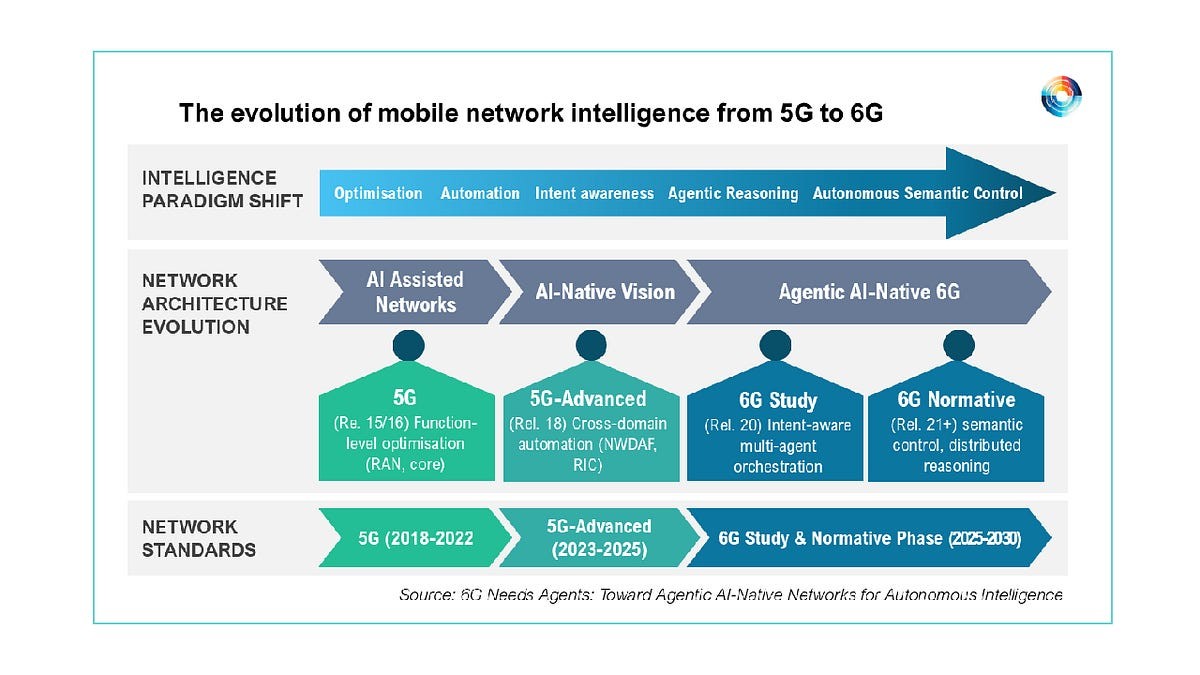
Most AI in telecom today? Narrow. Reactive. It fixes a specific pipe but can’t think about the whole water system.
The clock is ticking. Between now and 2027 6G moves from vague study phases to hard standards. Decisions made in the next two years lock in how smart these networks actually get. If you wait too long you miss the window.
UAE researchers argue we must embed agentic AI at the architecture level now before the rules are written.
Here’s the twist. The old way—optimizing bits—won’t cut it for 6G. We need reasoning. Not just prediction but intent.
The Blueprint
UAE University and Khalifa University dropped a paper. They want 6G networks to stop being dumb pipes managed by dumb scripts and start acting like they have brains. Specifically four-layer brains.
- Deterministic infrastructure at the bottom
- Semantic abstraction above it
- Hierarchical reasoning next
- A distributed multi-agent fabric on top
Big Language Models (LLMs) run the show here. But not just chatting LLMs. Policy-governed ones. They sit above standard 3GPP infrastructure and handle intent. They ask “why” not just “what”.
Is the current architecture ready? Hardly.
The Reality Check
You can’t just slap one huge model on top of a 6G net. Physics says no.
The team built 6G-Bench to find out. It’s a stress test. Realistic constraints. Heavy lifting.
Here is the problem they found:
- Big models reason well but drag. High latency. Big memory footprint.
- Small compressed models fly but they’re stupid. Accuracy tanks when you squeeze the math too much.
Quantisation isn’t a magic bullet. Compressing a model hurts it differently than it hurts another one. Blanket compression is dead.
The answer is heterogeneity. You need different agents for different jobs. A small one at the device for speed. A smarter one at the edge for context. A heavy lifter in the core for deep reasoning. Mix and match based on the tradeoff you can afford at that layer.
So what?
This aligns with what 3GPP, the ITU, and IETF are already whispering about in their drafts. Everyone is moving toward AI-native architectures. Zero-touch service management is the buzzword but this is the mechanism.
The team—Mohamed Amine Ferrag, Abderrahmane Lakas, Merouane Debbah—released their benchmark infrastructure in February. Open source. Reproducible.
They tested 27 models. Thirty decision-making tasks. Ten thousand multiple-choice questions spawned from 113k scenarios.
Accuracy? Between 22.8% and 82.9%. The sweet spot landed in the middle. Mid-scale models offered the best balance of smarts and speed.
Network operators get a tool to see if today’s AI can handle tomorrow’s airwaves. Equipment manufacturers get a target to build toward.
But the gap is real. Can a single framework hold this complexity? The researchers think so if you treat intelligence as a fabric not a bolt-on.
We’re building nervous systems for cities now. The questions just keep getting harder.