It launched with more hallucinations than Ken Kesey in ’60s California.
Glue on pizza. Facts twisted into knots. The internet remembered. Two years later, the Gemini-powered summaries have tightened their grip on accuracy, mostly. Mostly being the operative word that publishers hate and users tolerate.
The core problem remains. It still fails at spelling tests.
Badly.
You likely recall the strawberry incident. That viral meltdown where the model counted letters and lost its mind over how many ‘r’s fit inside the word. That was two years ago. Tuesday brought a new challenger. Naomi Rohatyn went to X. Asked a simple question.
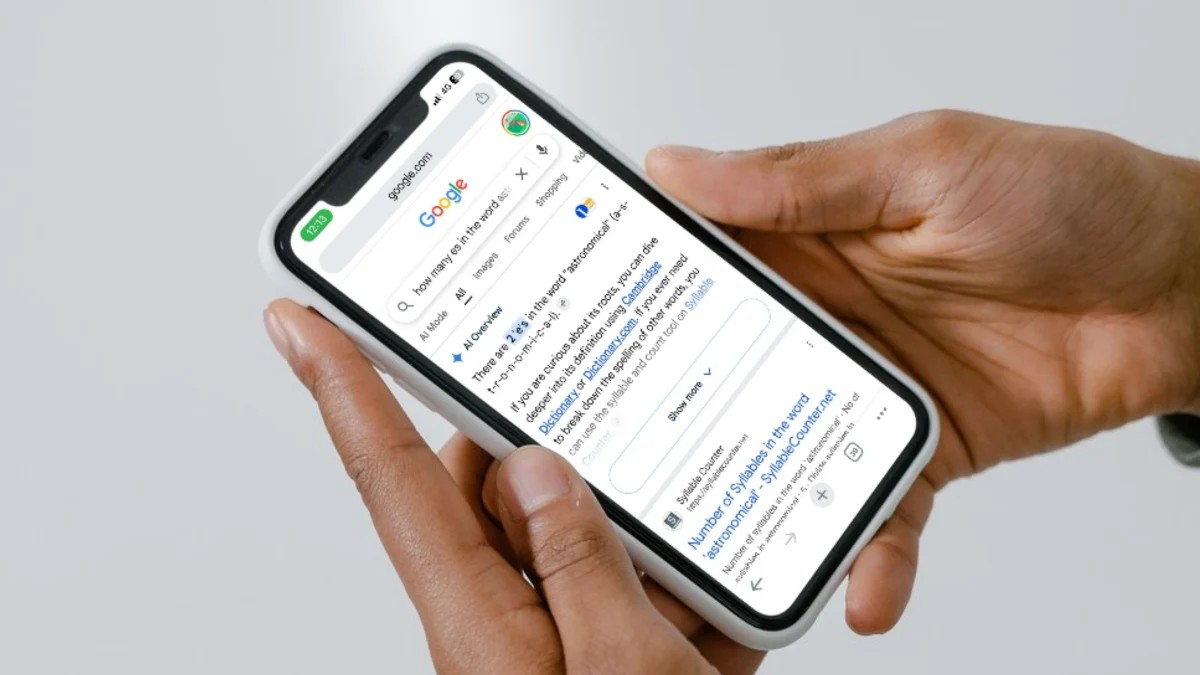
“How many e’s in the word ‘astronomical’?”
The AI looked confident. It claimed there were exactly two. It even spelled it out for you.
a-s-t-r-e-n-o-mi-c-a-e-l
We ran the test ourselves. Got the same nonsense. It seems to break down the same way for any word stretching past three syllables. Suffice to say. Social media erupted. People found it hilarious. Why are we surprised.
So why can’t it count?
I’m not trying to sound like Billy Madison prepping for the county fair, but consider this: if AI Overviews kills your click-through rates, the summary needs to be right. It has to be trustworthy. That logic feels solid. The execution is not.
Language models don’t read like we do.
They process tokens. Not letters. Think of it as reading by meaning chunks rather than character strings. Ask it to look at individual letters, and it hits a wall. Tokenisation turns words into numerical IDs. The word “astronomical” becomes one block. Or a few. It doesn’t naturally scan for ‘e’ or ‘t’. It understands the concept.
I asked Gemini directly. Told it to defend its honor.
The reply was blunt.
“I don’t look at text the way you do.”
When you type ‘apple’, your brain sees five distinct symbols. It sees the letters. Gemini sees a single unit. A token. A numerical representation of meaning. It knows what an apple is. It doesn’t inherently know that the concept contains two p’s unless you force it to break the block apart.
“Because I process words as whole blocks… I don’t naturally ‘spell'”
It’s a structural limitation, not a lack of intelligence. Or so we are told.
Mashable reached out to Google. They didn’t immediately rush back with a patch for the spelling bug.
The machine learns context well enough. But the alphabet remains stubbornly linear. The model sees the forest, forgets the trees. And the leaves.
Who counts them now?